
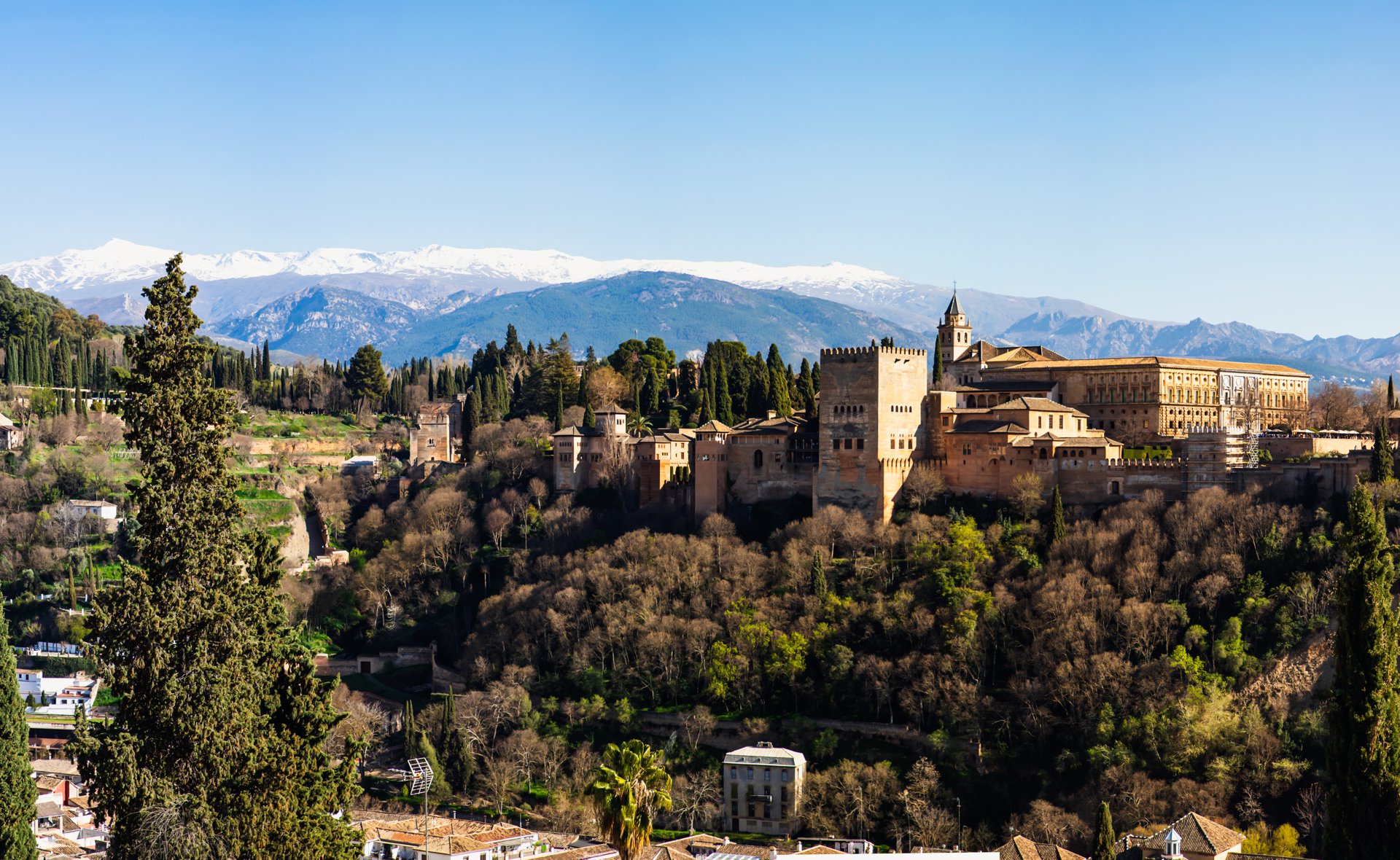
At the foot of the Sierra Nevada, Spain's most storied city holds eight centuries of empire, faith and artistry in its rose-gold light. For the traveller from the north, it offers something rarer than sunshine — the sensation of stepping directly into history.
There is a particular quality to the light in Granada. It arrives late in the afternoon, slanting across the red walls of the Alhambra until the whole fortress seems to glow from within, as though the stone itself remembers the fires and ambitions of the people who raised it. For a visitor stepping off a plane from Amsterdam or Copenhagen or Manchester — from the soft, forgiving greys of the north — that light is the first revelation. It is not merely warmer. It is older. It falls on a city that has spent a thousand years refusing to be anything other than entirely itself.
Most European cities tell a single story. Granada tells several at once, and has never troubled to reconcile them.
Begin with the word itself. Granada is the Spanish for pomegranate, and the fruit — split open, seeds spilling like garnets — has been the city's emblem for centuries, carved into fountains and pressed into the ironwork of its gates, a small red signature repeated across the old town. Scholars still debate whether the name truly descends from the fruit or from the Arabic *Gharnāṭa*, but the people of Granada long ago stopped caring. The pomegranate suits them: a hard shell concealing an interior of impossible richness, a single fruit holding countless separate jewels. No better metaphor exists for the city, or for what awaits the traveller patient enough to prise it open.
To understand Granada, you must first understand what it was the last of.
For nearly eight hundred years, much of the Iberian Peninsula belonged to al-Andalus — the Muslim civilisation that flourished in Spain while much of Europe stumbled through its harder centuries. This was a world of libraries and astronomers, of irrigation and philosophy, of poetry composed in courtyards cooled by running water. And as the Christian kingdoms of the north pressed slowly southward across the generations, city after city fell — Córdoba, Seville, Valencia — until only one jewel remained.
That jewel was Granada. From 1230, the Nasrid dynasty ruled here as the final Muslim kingdom in Western Europe: a mountain redoubt that survived, improbably, for more than two and a half centuries after the rest of al-Andalus had gone. It endured through diplomacy and tribute, through mountain geography and sheer nerve. And into this last kingdom, its rulers poured everything they knew of beauty.
The result crowns the hill above the city, and it is called the Alhambra.
The name comes from the Arabic *al-Qal'a al-Hamra* — the red castle — and from a distance it reads as a fortress: austere, militarily sober. This is a deception. Pass through its outer walls and you enter what its builders quite deliberately intended as an earthly vision of paradise. The Nasrid sultans, chief among them Yusuf I and Muhammad V in the fourteenth century, commissioned rooms of such intricacy that the eye simply cannot settle — honeycombed ceilings that seem to dissolve into pure geometry, walls dense with carved arabesques, and everywhere the sound of water, channelled and pooled and set leaping in fountains, most famously around the Court of the Lions.
Water, in the Islamic conception of paradise, is the ultimate luxury, and here it is treated as an art form. The engineers of the Alhambra carried it down from the Sierra Nevada and made it perform: cooling the air, mirroring the sky, murmuring beneath the poetry that runs in Arabic script along the walls. One inscription, repeated throughout the palace, translates simply as *there is no victor but God* — a phrase that would acquire a terrible irony in the years to come.
Above the palaces lie the gardens of the Generalife, the sultans' summer retreat, where cypress and rose and the constant trickle of channels create a serenity that has survived every conqueror since. To walk here at dusk, as swallows wheel over the towers and the mountains turn violet behind them, is to understand why people fought for eight centuries to hold this ground.
And then came the year that changed everything — not only for Granada, but for the planet.
On the second of January 1492, Muhammad XII — known to history as Boabdil, the last Nasrid sultan — surrendered the keys of the city to Ferdinand of Aragon and Isabella of Castile, the Catholic Monarchs whose marriage had united Christian Spain. With that handover, the centuries-long *Reconquista* was complete. Nearly eight hundred years of Muslim rule in Iberia ended in a single ceremonial gesture, on a winter morning, at the foot of these mountains.
Legend holds that as Boabdil rode into exile, he paused at a mountain pass to look back one final time on the city he had lost, and wept. The place is still called *el último suspiro del moro* — the Moor's Last Sigh. His mother, the story goes, offered no comfort, only a rebuke that has echoed down the centuries: that he did well to weep like a woman for what he had failed to defend like a man. Whether or not it happened, Granadans tell it still, because it captures something true about the melancholy woven through the city's beauty.
That same year, in the same conquered city, two further events set the modern world in motion. In the nearby town of Santa Fe — freshly built by the besieging army — Isabella and Ferdinand received a persistent Genoese navigator and agreed to fund his improbable voyage west. His name was Christopher Columbus, and within months he would stumble upon a hemisphere. And in the spring, the same monarchs signed the decree expelling Spain's Jews — the beginning of a long and painful unravelling that would later see the region's Muslim population, the *Moriscos*, forced to convert and eventually driven out as well.
It is important, standing in Granada today, not to romanticise this too easily. The city's astonishing layering of cultures was achieved at genuine human cost. What makes Granada so profoundly moving is precisely that it holds all of this at once: the glory and the loss, the triumph and the exile, pressed together in the same streets. This is not a city that resolves its contradictions. It simply carries them, with extraordinary grace.
The victors did not tear Granada down. They built upon it, and the seams are visible everywhere.
In the heart of the old town stands the Royal Chapel, commissioned so that Ferdinand and Isabella might be buried in the city that crowned their reign. Here, beneath ornate marble effigies, lie the Catholic Monarchs themselves, alongside their tragic daughter Joanna — remembered as *Juana la Loca*, Joanna the Mad — and her husband Philip the Handsome. Beside the chapel rises the great Renaissance cathedral, luminous and pale, begun in the full flush of Christian confidence.
Even the Alhambra itself was claimed. The Emperor Charles V, grandson of the conquerors, planted an immense circular Renaissance palace directly within the delicate Nasrid complex — a bold, deliberately incongruous statement of the new order set against the Moorish work it was meant to eclipse. Today the two styles stand side by side, a permanent architectural conversation between the civilisation that built the hill and the one that took it.
For a time, remarkably, the world nearly forgot the Alhambra. By the early nineteenth century the great palace had fallen into neglect, its courtyards colonised by squatters, its halls crumbling toward ruin.
Its rescue came, improbably, from an American. In 1829 the writer Washington Irving took up residence within the decaying palace and, enchanted, produced his *Tales of the Alhambra* — a collection of romantic sketches and legends that captivated readers across Europe and the New World. Suddenly Granada was fashionable again. The trickle of curious travellers became a flood, serious restoration began, and the palace was saved. It is a fitting twist in the city's story: that a monument to one vanished civilisation should be rescued by the imagination of a visitor from a country that did not yet exist when its stones were laid.
Yet Granada would be a poorer place if it were only a monument. Its genius is that its history is not sealed behind glass — it is still being lived.
Cross the valley from the Alhambra and climb into the Albaicín, the old Moorish quarter, and you enter a labyrinth that has barely changed in five hundred years. White houses lean over lanes too narrow for cars; behind high walls hide the *cármenes*, the traditional Granadan villas with their secret gardens. Climb to the viewpoint of San Nicolás at sunset — a pilgrimage every visitor eventually makes — and the whole Alhambra unfurls before you, floating above the city with the snow-capped Sierra Nevada rising behind it. Few urban views on the continent can rival it.
Higher still lies Sacromonte, the hillside of whitewashed caves where, for generations, Granada's Roma community made their homes in the living rock. It was here, in these cave dwellings, that the city developed its own smouldering strain of flamenco — the *zambra*, danced and sung in intimate, candlelit hollows. To sit close in one of these caves as the guitar begins and a single voice cuts loose is to witness an art form at its rawest and most electric. There is nothing polished about it, and that is entirely the point.
No account of the city is complete without Federico García Lorca, the poet and playwright who remains Granada's most beloved and most tragic son.
Born nearby in 1898, Lorca drew endlessly on Granada's landscapes, its Roma culture, and the aching *cante jondo* — the "deep song" of Andalusian tradition — that he considered the very soul of his homeland. He loved this city with an intensity that shaped everything he wrote. And it was here, in the terrible summer of 1936, at the outbreak of the Spanish Civil War, that he was seized and shot in the hills outside town. His body was never found. That Granada could produce such a voice and then destroy it remains, for many, the city's deepest wound — one more layer of beauty and loss in a place defined by their entanglement.
Lest all this suggest a city weighed down by its own gravity, be assured: Granada also knows how to live.
It is home to one of Spain's most cherished customs — the free *tapa*. Order a drink in almost any traditional bar and a plate of something will arrive unbidden alongside it: a few slices of *jamón*, a wedge of tortilla, a small bowl of stew. Order another, and a different dish appears. In the country that gave the world tapas, Granada remains one of the last cities to give them away, and an evening spent drifting from bar to bar — drink by drink, plate by plate — is among the great inexpensive luxuries of Southern Europe.
The food itself carries the same layered history as the streets: the almonds, honey, saffron and spice of its Moorish inheritance mingling with the hearty produce of the Andalusian countryside. To eat in Granada is, quite literally, to taste eight centuries of coexistence.
And then, when you least expect it, comes the improbable final flourish of geography.
Rising directly behind Granada is the Sierra Nevada — the "snowy range" — home to the highest peaks on the Spanish mainland. From roughly November into spring they wear a crown of snow visible from the city's rooftops, and their ski slopes lie less than an hour from the cathedral doors. It is entirely possible, on the right spring day, to ski in the morning and reach the Mediterranean coast by afternoon. For a visitor from the north, long accustomed to choosing between mountains and sea, sun and snow, the sheer abundance of it borders on the indecent.
Granada, in the end, is not a city that offers easy comfort or a single tidy narrative. It offers something far more valuable: the sense of standing at a genuine crossroads of the world, where empires met and merged and departed, and left their fingerprints on every wall.
Come for the Alhambra, certainly — no photograph has ever done it justice, and none ever will. But stay for the rest: the tangled lanes of the Albaicín, the voice rising in a Sacromonte cave, the free plate arriving with your wine, the snow glowing pink above the terracotta roofs. Stay for the particular melancholy and the particular joy that only a city with this much history can hold at the same time.
The traveller from the north comes to Granada expecting sunshine and returns having found something they did not know they were missing — the increasingly rare feeling of a place that is entirely, unrepeatably itself. Bring good shoes. Bring an appetite. And be warned: it will quietly recalibrate your sense of what a city can be.