

Marbella rewards the traveller willing to look past the obvious. Beyond the beach clubs and the boutiques lies a town of genuine depth and variety: a whitewashed old quarter laid out to the Moorish plan, ancient ruins, world-class glamour and a green mountain rising behind it all. What follows is a considered ten that balances the glossy and the historic, the celebrated and the quietly rewarding — from the marble halls of Puerto Banús to a hilltop that on clear days looks across the strait to Morocco. Take them at your own pace, leave time for a long lunch, and let the Costa del Sol's most storied resort reveal its many sides.
1. The Old Town
Behind the glossy seafront lies the Marbella that predates all the glamour — the *casco antiguo*, a maze of narrow, whitewashed lanes laid out to the Moorish plan and spilling over with geraniums and bougainvillea. Fragments of the old *alcazaba*, the Moorish castle walls, still stand among the houses, and every corner seems to open onto a hidden plaza or a tiled fountain. Delightfully free of traffic, it is a place to wander without purpose, ducking into artisan shops and tucked-away tapas bars. That such an intimate, ancient quarter survives at the heart of the coast's most famous resort is Marbella's happiest surprise.
2. Plaza de los Naranjos
At the centre of the old town lies its jewel: the Plaza de los Naranjos, the Orange Square, laid out by the Christian conquerors in the fifteenth century and ringed to this day with the fragrant trees that give it its name. Around it stand handsome historic buildings — the Renaissance town hall, a former governor's house, a small chapel — while café tables spill across the cobbles beneath the orange boughs. It is the beating social heart of Marbella, best enjoyed slowly, over a coffee or a glass of wine, as the life of the town drifts past. Few squares in Andalusia are more charming.
3. Puerto Banús
No visit to Marbella is complete without a look at Puerto Banús, the glittering marina that has been shorthand for Mediterranean excess since it opened in 1970. Here the superyachts moor stern-to along the quay, flanked by a parade of Ferraris and Lamborghinis and a run of the world's most exclusive boutiques. It is unabashed, theatrical and irresistibly fun — a place for people-watching above all else. Come at dusk, when the yachts light up and the promenade fills, take a seat at a waterside table, and simply enjoy the show. Whatever your budget, the spectacle is free.
4. The Golden Mile and the Marbella Club
Between the town and Puerto Banús runs the fabled Golden Mile, a leafy stretch of grand villas, five-star hotels and the palaces of the international wealthy. At its heart stands the Marbella Club, the discreetly luxurious hotel that a young Prince Alfonso von Hohenlohe opened in 1954 and, in doing so, launched the legend of Marbella itself. Even for those not staying, it is worth pausing here to sense the origins of the resort's glamour — perhaps over a drink in its gardens. This is where the jet set first came, and where a quiet fishing town became a byword for the high life.
5. Avenida del Mar and the Dalí Sculptures
Linking the old town to the seafront is the Avenida del Mar, a handsome pedestrian boulevard that holds one of Marbella's most unexpected treasures: a series of bronze sculptures by Salvador Dalí. A cluster of the surrealist master's works line the walk — elongated figures and dreamlike forms — set casually among the palms and fountains for anyone to admire, free of charge and without a museum in sight. It is a wonderfully democratic touch of high culture, and a lovely way to descend from the old town toward the beach. Keep an eye out, too, for the tiled benches of the adjoining Alameda gardens.
6. The Beaches and Seafront
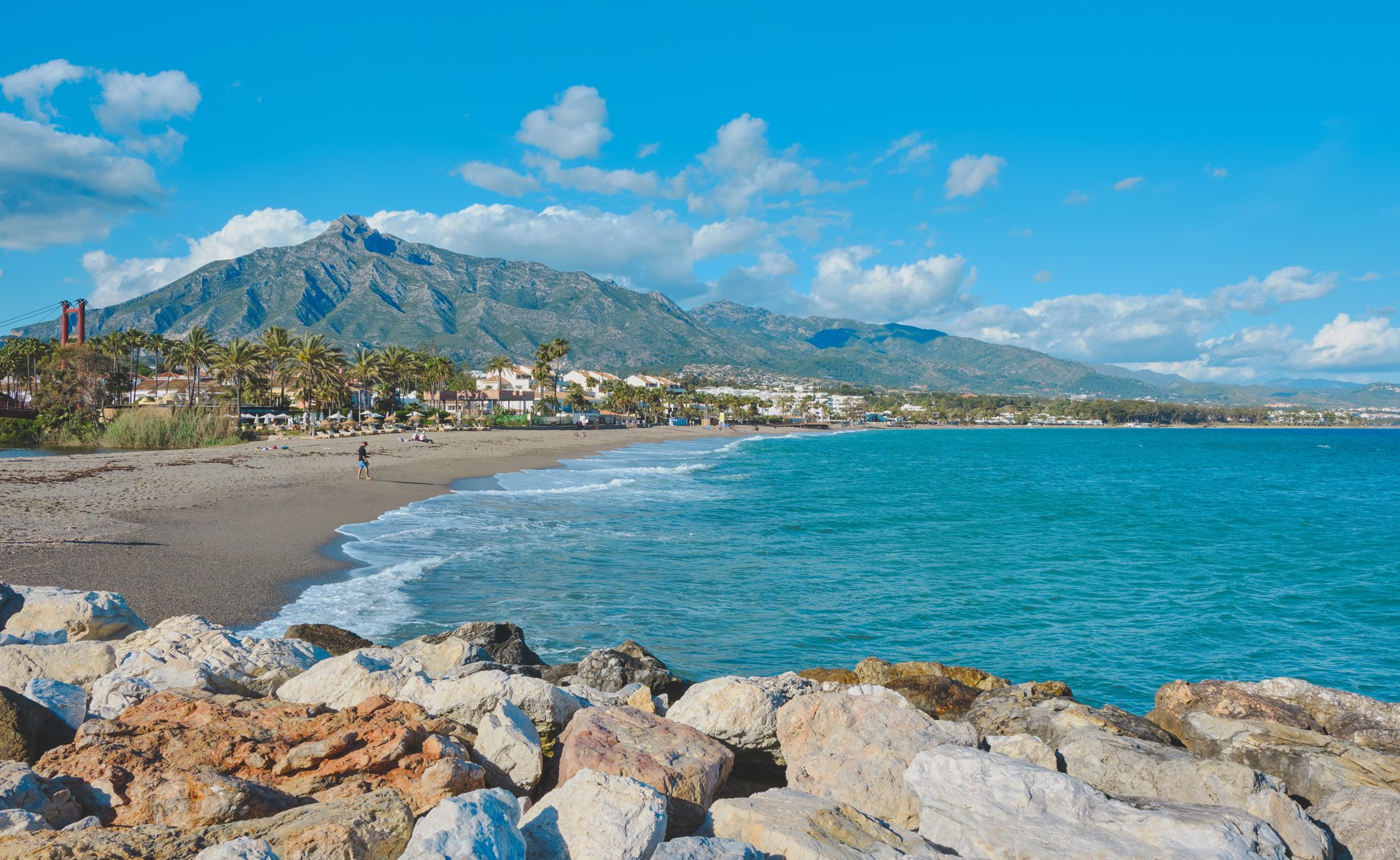
Marbella is, first and last, a beach town, and its long ribbon of golden sand remains the great draw. From the family-friendly stretches near the centre to the fashionable beach clubs further along the coast, the shoreline caters to every mood — whether you seek a lively *chiringuito* serving sardines grilled on skewers over open coals, a chic day-bed and a cocktail, or simply a quiet patch of sand and the warm Mediterranean. A broad seafront promenade, the Paseo Marítimo, runs for miles behind it, perfect for a stroll or a cycle. With more than three hundred days of sunshine a year, the beach here is less an activity than a way of life.
7. The Museum of Contemporary Spanish Engraving
For a dose of culture, seek out the Museo del Grabado Español Contemporáneo, tucked into a beautifully restored sixteenth-century hospital in the old town. Spain's foremost museum devoted to the art of the print, it holds an outstanding collection of engravings and lithographs by the giants of modern Spanish art — Picasso, Miró, Dalí, Tàpies and more. Intimate and rarely crowded, it offers a rewarding hour away from the sun, in a historic building that is itself worth the visit. It is exactly the kind of quiet, cultivated pleasure that the glossier version of Marbella tends to obscure.
8. The Roman Coast
Marbella's story stretches back far beyond the jet set, and its most tangible ancient remains lie a short drive west, near San Pedro de Alcántara. Here, within a few kilometres of one another, stand the well-preserved Roman thermal baths of Las Bóvedas and the early Christian basilica of Vega del Mar, among the oldest surviving Christian buildings in Spain. Nearby, the seaside Roman villa of Río Verde retains fine mosaic floors. Modest and uncrowded, these sites reward the curious traveller with a vivid sense of just how long this beautiful coast has been prized — and lived upon.
9. The Church of the Incarnation
Presiding over the old town is the Iglesia de Nuestra Señora de la Encarnación, Marbella's principal church and a fine example of Andalusian Baroque. Begun in the early seventeenth century, it boasts an elaborately carved rococo doorway — a flourish of warm stone amid the whitewash — and a serene, lofty interior. Music lovers should note its celebrated organ, the "Órgano del Sol Mayor," among the largest in the region and the centrepiece of regular concerts. Set on a peaceful square just steps from the bustle, it offers a quiet moment of grandeur at the heart of the old quarter.
10. La Concha and the Sierra Blanca
Rising dramatically behind the town is La Concha, the "shell-shaped" peak of the Sierra Blanca that crowns every Marbella skyline. For those who tire of the sand, its slopes offer a wilder counterpoint: pine-scented walking trails, cooler mountain air and, from the higher paths, sweeping panoramas that on clear days reach across the strait to the mountains of Morocco. The Refugio de Juanar, a former hunting lodge tucked into the hills, makes an ideal base for a hike or an unhurried country lunch. It is a fitting reminder that Marbella's pleasures are not confined to the water's edge — a breath of fresh air, quite literally, above the glamour.
Consider Visiting
Marbella makes an ideal base for exploring the wider region, and three excursions in particular are too good to miss. Each lies within comfortable reach for a day out.
Ronda
Perched atop a sheer cliff an hour or so inland, Ronda is one of Andalusia's most spectacular towns. It is split in two by the El Tajo gorge, which plunges a hundred metres to the river below and is spanned by the extraordinary Puente Nuevo, an eighteenth-century bridge that ranks among the most photographed sights in Spain. Ronda is also cradle to the modern art of bullfighting, and its elegant eighteenth-century bullring is one of the oldest in the country. Add a well-preserved Moorish old quarter, ancient Arab baths and views that entranced Hemingway and Orson Welles, and Ronda more than earns the winding drive.
Mijas Pueblo
Closer to hand, a mere half-hour away, the whitewashed village of Mijas clings to a hillside high above the coast — a postcard-perfect *pueblo blanco* of narrow lanes and flower-decked balconies. Its most celebrated quirk is the fleet of "burro-taxis," the donkeys that have ferried visitors around the village for generations. Beyond the novelty, Mijas rewards wandering: a curious near-oval bullring, a shrine carved into the living rock, craft shops and, above all, sweeping Mediterranean views that on a clear day take in the whole sweep of the Costa del Sol. It is charm distilled, and a delightful morning's escape.
El Caminito del Rey
For the adventurous, no excursion compares to the Caminito del Rey — the "King's Little Path" — a vertiginous walkway pinned to the walls of a dramatic gorge a little over an hour north. Once notorious as one of the world's most dangerous trails, it was rebuilt and reopened in 2015 as a safe but thrilling boardwalk, clinging to sheer cliffs as much as a hundred metres above the river. The walk of some seven kilometres offers scenery of jaw-dropping grandeur. Tickets must be booked well in advance, a head for heights is essential, and the reward is one of the most exhilarating experiences in southern Spain.