

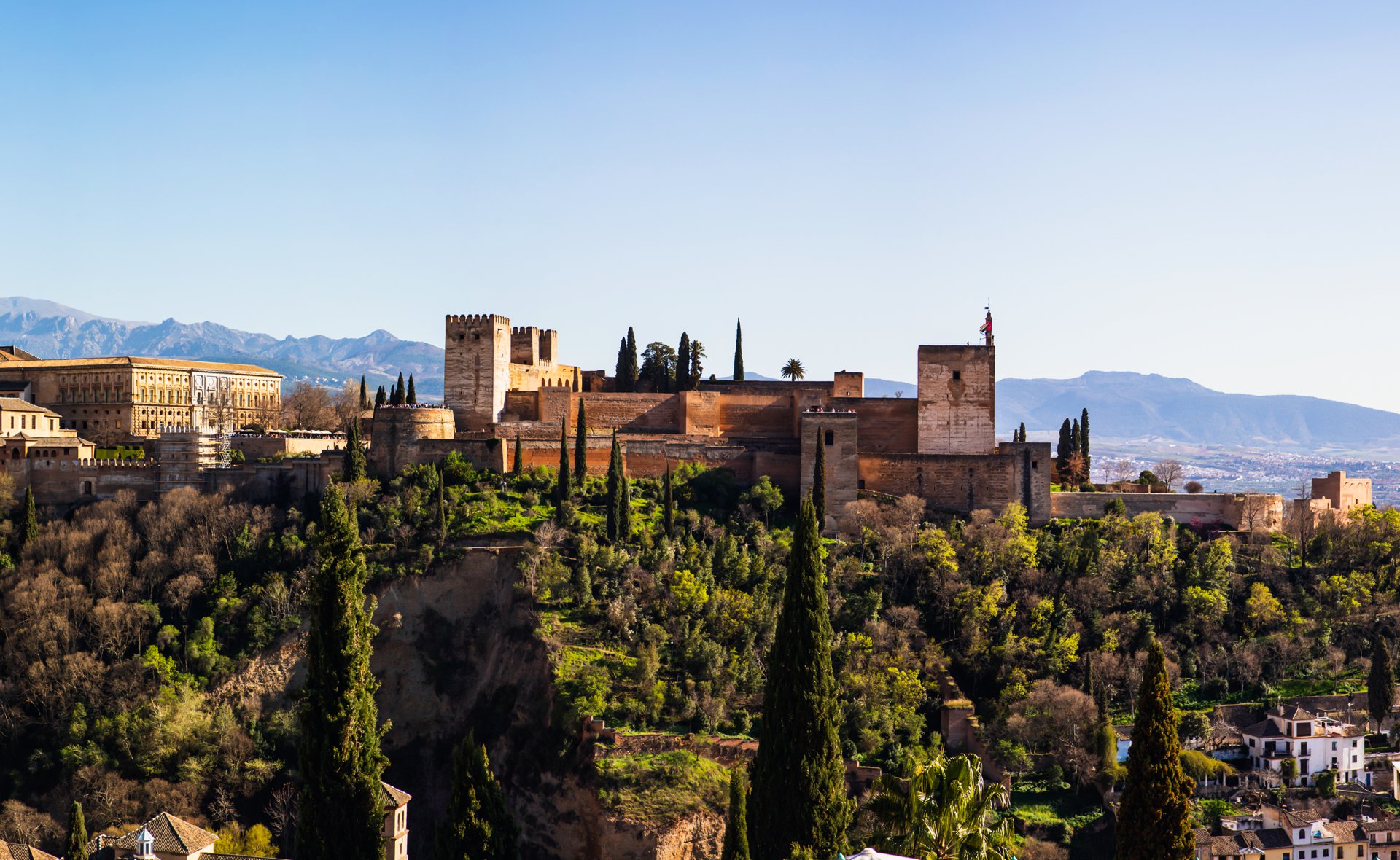
Some cities reveal themselves slowly. Granada offers up its treasures at every turn, one civilisation layered atop another. A single visit cannot exhaust it, but a well-chosen ten will carry you from the palaces of the Nasrid sultans to the mountains at their back, by way of tangled medieval lanes, candlelit caves and a cathedral of luminous marble. What follows is not a checklist to be raced through but an invitation to linger. Wear good shoes, surrender your schedule, and let the city set the pace. These are the ten things no traveller to Granada should leave without seeing.
1. The Alhambra
The reason most travellers come, and a monument that outstrips every photograph ever taken of it. Rising red above the city, the Alhambra was the palace-fortress of the Nasrid sultans, and its Nasrid Palaces remain the most exquisite Islamic interiors in Europe — honeycombed ceilings, filigree stonework, and the celebrated Court of the Lions, where twelve marble beasts stand guard around a central fountain. Explore the military Alcazaba for sweeping views from the Torre de la Vela, then simply sit and let the intricacy work on you. Book your timed ticket weeks ahead: entry to the Nasrid Palaces is strictly limited, and it sells out.
2. The Generalife
Just above the Alhambra lie the gardens that were its sultans' escape — the Generalife, from the Arabic for "the architect's garden." This was the royal summer retreat, and it remains a masterclass in the Moorish art of paradise-making. Water is everywhere: channelled along the Patio de la Acequia in slender arcing jets, pooled beneath cypresses, set murmuring among roses and myrtle. Where the palaces overwhelm with detail, the Generalife soothes. Come in late spring, when the beds are in full bloom and the fountains catch the light, and you will understand why the sultans preferred to govern from within a garden.
3. The Albaicín
Facing the Alhambra across a narrow valley, the Albaicín is Granada's old Moorish quarter and a UNESCO treasure in its own right — a labyrinth of whitewashed houses and lanes too steep and slender for cars, barely altered in five hundred years. Behind high walls hide the *cármenes*, secret villa-gardens glimpsed only through half-open gates. Climb, and keep climbing, until you reach the Mirador de San Nicolás, where at sunset the whole Alhambra floats before you, gilded, with the snow-capped Sierra Nevada rising behind. It is among the most beautiful urban views in all of Europe, and no image prepares you for it.
4. Sacromonte
Higher still, on a sun-baked hillside northeast of the Albaicín, lies Sacromonte — the district of whitewashed caves dug into the rock, home for generations to Granada's Roma community. It was here that the city forged its own smouldering strain of flamenco, the *zambra*, and to this day the caves host performances of extraordinary rawness. Squeeze into a candlelit hollow as the guitar begins and a single voice tears loose, and you witness the art form stripped of all polish and pretence. Visit the Museo Cuevas del Sacromonte by day to understand the lives once lived inside these cool, curious dwellings.
5. The Royal Chapel
Down in the busy heart of the old town stands the Capilla Real, and few small buildings in Spain carry such historical weight. This is where Ferdinand and Isabella — the Catholic Monarchs who took Granada in 1492 and funded Columbus in the same breath — chose to be buried, in the city that crowned their reign. Beneath finely carved marble effigies, their plain lead coffins rest in the crypt alongside those of their daughter, Joanna the Mad, and her husband. The chapel also guards Isabella's private art collection and Ferdinand's sword. Quiet, sombre and profoundly moving, it rewards an unhurried visit.
6. Granada Cathedral
Beside the Royal Chapel rises the great cathedral, begun in 1523 on the site of the city's former main mosque and among the finest expressions of the Spanish Renaissance. Step inside and the effect is startling: after the shadowed intimacy of the Moorish quarters, here is a vast interior of dazzling white, its soaring Corinthian columns drawing the eye upward into light. The magnificent domed Capilla Mayor, ringed with stained glass, forms a theatrical climax. Designed in part by the master architect Diego de Siloé, the cathedral is Christian Granada's grandest statement — luminous, confident and unmistakably a monument to a new age.
7. La Cartuja
For those willing to stray a little beyond the obvious, the Monastery of La Cartuja delivers one of the city's great surprises. From the outside, this Carthusian charterhouse on Granada's northern edge seems restrained. Within, it erupts into some of the most exuberant Baroque in all of Spain. The sacristy in particular is a riot of swirling marble, gilded stucco and dizzying *trompe-l'oeil* — an interior of almost hallucinatory richness, and a favourite among those in the know. Far quieter than the Alhambra, it offers the rare pleasure of a world-class monument enjoyed at leisure. Take a taxi or bus; the small detour repays itself many times over.
8. The Sierra Nevada
Granada's most improbable attraction rises directly behind the city: the Sierra Nevada, crowned by Mulhacén, the highest peak on the Spanish mainland. In winter its slopes host Europe's southernmost ski resort, less than an hour from the cathedral doors — near enough that, on the right spring day, you might ski in the morning and reach the Mediterranean by afternoon. Come summer, the melting snows give way to a spectacular national park laced with hiking trails and glacial lakes. For a visitor used to choosing between mountains and sea, the sheer proximity of both here feels almost like an indulgence.
9. The Darro Valley
Between the Albaicín and the Alhambra runs the little river Darro, and the streets that trace it form perhaps the loveliest walk in the city. The Carrera del Darro, lined with old stone bridges and Renaissance façades, is frequently called one of Spain's most beautiful streets; along it stands El Bañuelo, an eleventh-century Arab bathhouse and among the best-preserved in the country. The path continues to the Paseo de los Tristes, from where the floodlit Alhambra looms overhead at night. Walk it slowly, pause on a terrace for a drink, and let the centuries settle quietly around you.
10. The Alcaicería and Calderería
Finally, to feel the pulse of Moorish Granada still beating, lose yourself in the old market quarter beside the cathedral. The Alcaicería, once the city's grand silk bazaar, survives as a warren of narrow lanes hung with lanterns, ceramics, spices and textiles. A few steps away, Calle Calderería Nueva — affectionately known as "little Morocco" — climbs between *teterías*, the fragrant tea houses where you can linger over sweet mint tea and pastries much as travellers have for centuries. It is unashamedly atmospheric, a touch touristy, and entirely irresistible: proof that in Granada, the past is never merely on display. It is lived.
Honourable Mentions
Ten is a cruel constraint in a city this rich, and a handful of remarkable places inevitably fall just outside it. Three in particular reward the curious traveller with a little time to spare.
The Palace of Charles V
Planted incongruously within the Alhambra itself stands the palace of the Emperor Charles V, grandson of the monarchs who conquered the city. Designed by Pedro Machuca from 1527, it is a work of severe High Renaissance grandeur — and its great secret lies within: a perfect two-storey circular courtyard, ringed by colonnades, set inside an otherwise square building. The contrast with the delicate Nasrid work surrounding it could not be sharper, and that is precisely the point. Today it houses the Alhambra Museum and the city's fine-arts collection, and the courtyard, remarkably, can be entered free of charge.
The Corral del Carbón
Tucked in a lane behind the Alcaicería survives one of the rarest treasures in Granada: a complete Nasrid caravanserai, the only one of its kind preserved in Spain. Built in the fourteenth century as an *alhóndiga* — a merchants' inn where traders lodged and stored their goods — it later served as a coal yard, which gave it the earthy name it still bears. Pass beneath its exquisite horseshoe-arched portal, richly carved with Arabic inscription, into the calm of its central courtyard, and you step directly into the commercial life of the Moorish city. It is easily missed, free to enter, and quietly extraordinary.
The Huerta de San Vicente
On the southern edge of the old town, amid a public park that was once a family orchard, stands the modest white house where Federico García Lorca spent his last summers. Now a museum, the Huerta de San Vicente preserves the poet's world almost as he left it: his desk and piano, his manuscripts, the balcony from which he looked out toward the fertile Vega he so loved. It was from Granada, in the summer of 1936, that he was taken to his death. After the grandeur of palaces and cathedrals, this intimate, sorrowful place offers something rarer still — the presence of the man himself.